- Home Page /
- Books /
- Children's & Kids' Books /
- Ages 3-5 Kids' Books /
- When Money Dies: The Nightmare of Deficit Spending, Dev...
0 ratings

Item #:
71155025
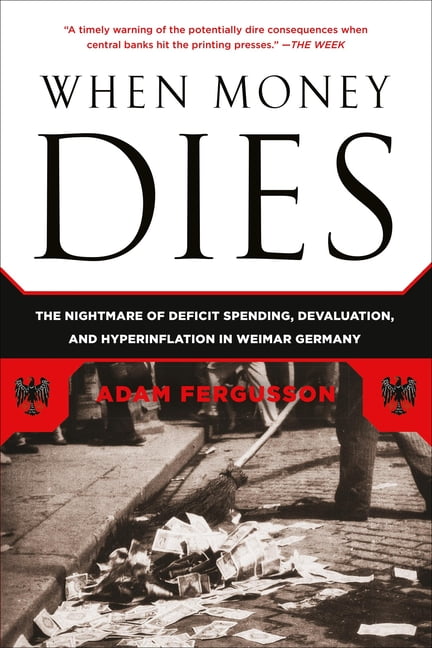
When Money Dies: The Nightmare of Deficit Spending, Devaluation, and Hyperinflation in Weimar Germany, Paperback
Item #:
71155025
€ 25
Price Details
Excluding Shipping & Custom charges ( Shipping and custom charges will be calculated on checkout )
*All items will import from US
0 ratings
Write a review
In stock
 Imported from USA store
QTY:
Order now and get it around Monday, July 06
Secured transaction
Ubuy works hard to protect your security and privacy. Our advanced payment security system ensures confidentiality by encrypting your information during transmission using AES (Advanced Encryption Standards) and SSL (Secure Socket Layer) protocols. Your payment details are 100% secure as we do not share your payment details with third party sellers.
Our Top Logistics Partners


Germany in 1923 provides a vivid, compelling, sobering moral tale.

Buy Now Pay Later

Fast
Shipping

Free
Return*

Secure Packaging

100% Original Products

PCI DSS Compliance

ISO 27001 Certified


Note: Step Down Voltage Transformer required for using electronics products of US store (110-120). Recommended power converters Buy Now.


What Stands Out
In-depth Analysis
Explore the intricate dynamics of Weimar Germany’s economy, showcasing how deficit spending led to catastrophic hyperinflation, enhancing reader understanding of historical financial crises.
Historical Context
Provides a comprehensive background on post-WWI Germany, offering insights into political and economic conditions that precipitated financial collapse, making it essential for history and economics enthusiasts.
Lessons for Today
Draws parallels between Weimar's plight and contemporary financial issues, equipping readers with critical insights into potential pitfalls of modern economic policies and their consequences.
Product Details
- When Money Dies is a classic history book that explores the nightmare of deficit spending, devaluation, and hyperinflation in Weimar Germany.
- The book was originally published in 1975 by William Kimber.
- It provides a vivid and compelling account of what happens when a nation's currency depreciates beyond recovery.
- In 1923, the German republic experienced a barter economy as its currency became effectively worthless.
- Expensive items like cigars and artworks were exchanged for basic necessities like bread.
- The financial chaos in Germany led to severe social unrest and the loss of life savings.
| Book format | Paperback |
| Fiction/nonfiction | Non-Fiction |
| Genre | Business & Investing |
| Publication date | October, 2010 |
| Pages | 288 |
| Reading level | Preschool |
| Subgenre | Finance |
| Series title | No Series |
| Number in series | 1 |
| Edition | 1 |
| Publisher | PublicAffairs |
| Original languages | English Language |
| Translator | No Translator info |
| Translated from | No Translated Form |
| Language | English |
| Edu focus | Solar System & Astronomy |
| Educational level | High School |
| Awards won | No Awards Won in the past |
| Is collectible | N |
| Occasion | NO SPECIAL OCCASSION |
| Character group | No Character Group |
| Illustrator | No Illustrator Information |
| Editor | No editor info found |
| Binding type | Perfect Binding |
| Digital file format | No Digital File Format |
| Digital reader format | NO DIGITIAL READER FORMAT |
| Digital audio file format | No Digital Audio Format |
| Narrator | No Narrator Info Found |
| Recording time | 0 min |
| Number of discs | 1 |
| Retail packaging | Single Piece |
| Assembled product dimensions (l x w x h) | 5.40 x 0.90 x 8.20 in (13.7 x 2.3 x 20.8 cm) |
| Assembled product weight | 0.65 lb (290 grams) |
| Sport | No Sport Information |
| Bisac subject heading | Business & Economics |
Who Should Buy?

-
Economics Students
Students studying economics will benefit from understanding historical hyperinflation and its impacts on economies and societies.
-
History Enthusiasts
Those interested in history will gain insights into the Weimar Republic's economic challenges and their historical context.
-
Financial Analysts
Financial professionals can draw parallels between past and present economic crises, enhancing their strategic decision-making capabilities.

-
General Readers
Casual readers might find the subject matter too complex and the writing style less engaging or too academic.
-
Quick Learners
Readers looking for a brief overview or quick tips might find the detailed analysis overwhelming and time-consuming.
-
Fiction Lovers
Those who prefer fictional narratives may not appreciate the non-fiction and historical analysis presented in this book.
Product Description
When Money Dies: The Nightmare of Deficit Spending, Devaluation, and Hyperinflation in Weimar Germany, Paperback
Have any Query? Chat with us
Product Buying Guide
When Money Dies: The Nightmare of Deficit Spending, Devaluation, and Hyperinflation in Weimar Germany is a classic history book that explores the consequences of a nation's currency depreciating beyond recovery. Originally published in 1975, this book provides a vivid account of Germany's experience in 1923 when their currency became effectively worthless. This buying guide will provide you with the product specifications, key features, usage scenarios, comparisons with competitors, user reviews, price analysis, and buying considerations to help you make an informed decision.
Product Specifications
- Author: Adam Fergusson
- Paperback: 320 pages
- Publisher: PublicAffairs; 1st edition (September 16, 2010)
- Language: English
- ISBN-10: 1586489941
- ISBN-13: 978-1586489946
Key Features
- Classic history book on hyperinflation in Weimar Germany
- In-depth exploration of the consequences of a depreciating currency
- Provides valuable insights into economic and social turmoil
- Relevant in understanding the potential impact of deficit spending and devaluation
- Compelling storytelling and vivid descriptions
- Educational and thought-provoking
Usage Scenarios
- For history enthusiasts interested in economic and political events
- For those studying the impact of hyperinflation on society
- For individuals interested in gaining insights into monetary policies and inflation
- As a supplementary resource for economics or history courses
- For anyone curious about the consequences of unsustainable economic practices
Some User Review
- This book is an eye-opening account of the devastating effects of hyperinflation. It provides a deeper understanding of how economic policies can have dire consequences. Highly recommended for anyone interested in history and economics.
- I found When Money Dies to be a fascinating and engaging read. It offers valuable insights into a historical event that still holds relevance today. The author's storytelling skills make it an enjoyable and informative book.
- As an economics student, I found this book to be an essential read. It helped me understand the complexities of hyperinflation and its impact on society. The author presents the information in a clear and concise manner.
- This book offers a cautionary tale that is still relevant in today's economic climate. It serves as a reminder of the dangers of unchecked government spending and the consequences that can follow. I highly recommend reading When Money Dies.
Competitors
- When Money Dies is reasonably priced for a paperback book of its kind. Considering the valuable insights and historical significance it offers, it provides excellent value for money.
- The price of When Money Dies is competitive compared to similar books in this genre. It offers a comprehensive exploration of hyperinflation and its consequences at an affordable price.
- While the exact price may vary depending on the retailer and edition, When Money Dies generally falls within the average price range for books of its type. It offers a compelling narrative and educational value.
- Considering the relevance and importance of the topic, When Money Dies is priced reasonably. It is a worthwhile investment for those interested in understanding the consequences of hyperinflation.
Buying Considerations
- When purchasing When Money Dies, consider your interest in history, economics, and socio-political events.
- Think about whether you prefer paperback or digital editions.
- Take into account the expected delivery time if purchasing from an online retailer.
- Consider purchasing When Money Dies as a gift for history buffs or economics enthusiasts.
- If you enjoy thought-provoking and educational books, When Money Dies is a great addition to your collection.
Conclusion
When Money Dies: The Nightmare of Deficit Spending, Devaluation, and Hyperinflation in Weimar Germany is an essential read for history and economics enthusiasts. Through a captivating narrative, this book explores the consequences of a depreciating currency and offers valuable insights into economic and social turmoil. Whether you are interested in studying historical events or gaining a deeper understanding of monetary policies, When Money Dies is a thought-provoking and educational resource that will not disappoint.
View LessWhen Money Dies: The Nightmare of Deficit Spending, Devaluation, and Hyperinflation in Weimar Germany is a classic history book that explores the consequences of a nation's currency depreciating beyond recovery. Originally published in 1975, this book provides a vivid account of Germany's experience in 1923 when their currency became effectively worthless. This buying guide will provide you with the product specifications, key features, usage scenarios, comparisons with competitors, user reviews, price analysis, and buying considerations to help you make an informed decision. Continue Reading
Customer Questions & Answers
-
Question:
What are some examples of the drastic effects of hyperinflation mentioned in the book?
Answer: Expensive items like cigars, artworks, and jewels were exchanged for basic staples; a cinema ticket could be bought for a lump of coal. -
Question:
What is the relevance of the historical events to modern economic policies?
Answer: The book draws parallels with modern quantitative easing and deficit financing, warning about the potential consequences. -
Question:
What is the main takeaway from the book?
Answer: The book serves as a cautionary tale about the dangers of unchecked hyperinflation and the importance of maintaining monetary discipline.
Adam Fergusson Ages 3-5 Kids' Books Editorial Review
No editorial reviews found
Customer Reviews & Ratings
1 customers ratings
-
5 Star
100%
-
4 Star
0%
-
3 Star
0%
-
2 Star
0%
-
1 Star
0%
Review this product
Share your thoughts with other customers
Product Price History
Important information
- Limitations : For products shipped internationally, please note that any manufacturer warranty may not be valid; manufacturer service options may not be available; product manuals, instructions, and safety warnings may not be in destination country languages; the products (and accompanying materials) may not be designed in accordance with destination country standards, specifications, and labeling requirements; and the products may not conform to destination country voltage and other electrical standards (requiring use of an adapter or converter if appropriate). The recipient is responsible for assuring that the product can be lawfully imported to the destination country. When ordering from Ubuy or its affiliates, the recipient is the importer of record and must comply with all laws and regulations of the destination country.
- Not all the products listed on Ubuy are for sale, as Ubuy is a global search engine. Products are subject to export/trade regulations.
€ 25
Order now and get it around Monday, July 06
This item is not restrict in my country.(Please click on above link if this item is not restrict in your country, So our team will review and allow.)
QTY:
Secured transaction
Ubuy works hard to protect your security and privacy. Our advanced payment security system ensures confidentiality by encrypting your information during transmission using AES (Advanced Encryption Standards) and SSL (Secure Socket Layer) protocols. Your payment details are 100% secure as we do not share your payment details with third party sellers.
Our Top Logistics Partners
Fastest cross-border delivery
Features & Benefits
- Classic history of a nation's currency depreciating beyond recovery
- Describes the drastic effects of hyperinflation on society and economy
- Highlights the consequences of deficit financing and lack of monetary discipline
- Draws parallels between historical events and modern economic policies
- Serves as a cautionary tale for potential future economic crises